
hi-res-ac

DLC (CVD) Coating

Complex Geometry. Seamless Protection.
Request A Quote

Diamond-Like-Carbon (DLC) 

Chemical Vapor Deposited DLC (CVD) coatings from Advanced Coating Technologies Inc. offer unmatched conformality and coverage—ideal for components with complex geometries or internal surfaces. Using reactive gases our CVD processes create dense, high-purity coatings that bond at the molecular level, ensuring long-term resistance to wear, heat, and chemicals.


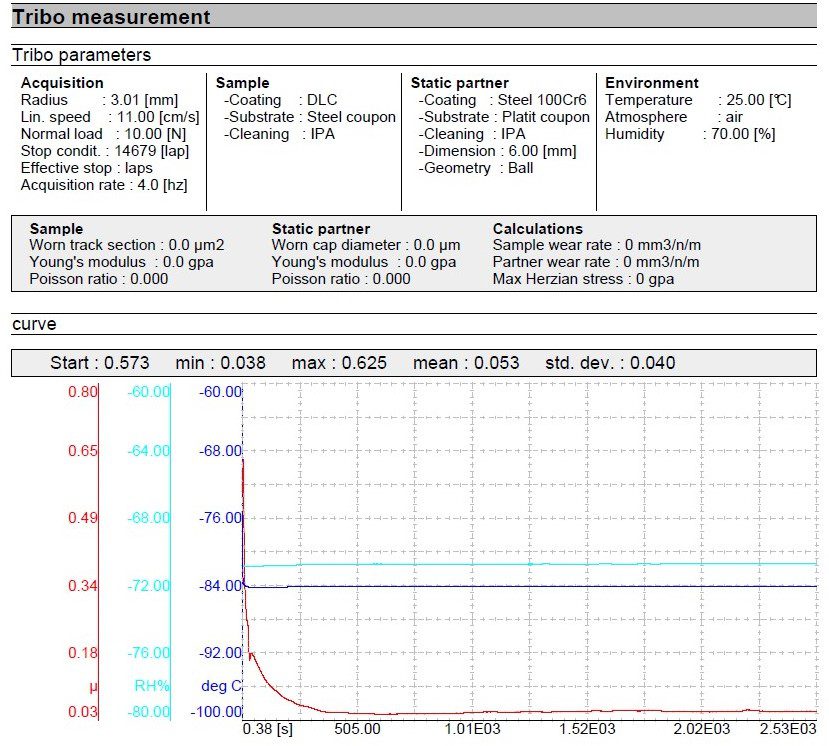
The key benefit of DLC coatings are their low coefficient  of friction (COF). Our standard DLC coating is a a-C:H:Si coating with a COF of about 0.03-0.06 under a normal load of 10N using a pin-on-disc Tribometer.

Other Key Benefits

Full-Surface Coverage on Intricate Parts
Ensures comprehensive protection and durability, even in complex geometries, enhancing the longevity of components.
Excellent Thermal and Chemical Stability
Resistant to extreme temperatures and harsh chemicals, maintaining performance and preventing degradation over time.
High Hardness and Abrasion Resistance
Provides superior surface hardness, reducing wear and tear, and extending the lifespan of the coated material.
Strong Metallurgical Bond
Creates a robust connection between the coating and substrate, ensuring reliability under stress and preventing delamination.
Ideal for Extreme Operating Environments
Designed to withstand challenging conditions, making it suitable for applications in aerospace, automotive, and heavy machinery.
Consistent Coating Thickness and Performance
Delivers uniformity in application, ensuring predictable behavior and performance across all components.

Diamond-Like Hardness with Industry-Low Friction

Diamond-like carbon coating is a thin-film surface treatment that deposits an amorphous carbon layer onto components through CVD (Chemical Vapor Deposition). The resulting film combines very high hardness with diamond-like hardness characteristics and extremely low friction, creating a surface that resists wear, corrosion, and chemical attack. Standard a-C:H:Si DLC reaches HV 1,600 with a coefficient of friction between 0.05 and 0.1, while Si free DLC achieves a hardness of about HV 2,600. Unlike line-of-sight PVD processes, CVD-applied diamond-like coating uses reactive gases that reach all exposed surfaces, providing full coverage on parts with internal geometries and recessed features.

Our DLC coating service applications span automotive drivetrain components, firearms slides and bolt carriers, medical instruments, aerospace precision mechanisms, and industrial bearings. The coating's chemical inertness makes it resistant to bodily fluids, cleaning agents, and sterilization chemicals, while its low friction reduces energy loss and maintenance requirements on high-cycle components.

Diamond-Like Hardness
Up to HV 2,400

CVD Applied
Full-Surface Coverage

Low Friction. High Performance.

Advanced Performance with DLC Coatings

Our diamond-like carbon coating delivers exceptional surface protection, wear resistance, and thermal stability for high-performance components. This advanced diamond-like coating technology mimics the extreme hardness of diamond and the low-friction properties of carbon, making it ideal for demanding applications. Through our expert DLC coating service, we ensure every layer of diamond-like carbon is applied with precision and consistency, delivering consistent, high-quality finishes engineered for precision. The result is a long-lasting, high-performance service that enhances tool life, reduces maintenance, and improves efficiency in real-world operating environments.

Why Choose Our DLC Coating Service

Extremely low coefficient of friction (COF 0.05 to 0.1), reducing energy loss on sliding, rotating, and cycling parts

Chemical inertness providing corrosion protection against bodily fluids, solvents, and sterilization agents

Extended service life of tools, precision mechanisms, firearms components, and medical instruments

Very high hardness with diamond-like hardness characteristics (HV 1,600 standard DLC, HV 2,400 DLC Rainbow)

Full-surface coverage on internal geometries and recessed features through CVD deposition

Consistent coating thickness of 1 to 4 µm applied under ISO 9001:2015 quality controls with in-house friction, thickness, and adhesion verification

Enhanced surface durability and scratch resistance extending component service life

Reduced component maintenance, cleaning frequency, and unplanned downtime on high-cycle assemblies

Multiple diamond-like coating variants available (standard DLC, DLC Rainbow, X-LC Shadow) to match specific performance and visual requirements

Frequently Asked Questions

What makes CVD different from PVD?

CVD uses chemical reactions at high temperatures to form a coating, making it ideal for complex geometries and internal surfaces, unlike line-of-sight PVD methods.

What industries commonly use CVD coatings?

CVD is widely used in aerospace, semiconductor, medical, and high-temperature tooling industries due to its durability and precision.

How thick are CVD coatings?

Thickness can range from 1 to 5 microns, depending on the material and application, making it suitable for high-performance environments.

Can CVD coatings withstand extreme temperatures?

Yes. CVD coatings are known for excellent thermal stability and can perform in temperatures exceeding 500°C, depending on the material.

Is CVD safe for medical or food-contact parts?

Yes, certain CVD coatings meet biocompatibility and food-safety standards when processed and applied correctly.

What advantages does a diamond-like carbon coating provide for industrial components and tools?

Our DLC coating service improves wear resistance, lowers friction, and increases durability for high-performance components. It is widely used in aerospace, medical, and tooling industries to extend lifespan and maintain efficiency under demanding operating conditions.

Can DLC coating be applied over an existing PVD coating, or does the part need to be stripped first?

In most cases, the existing coating should be stripped before applying DLC to achieve proper adhesion. However, some applications intentionally use a PVD adhesion layer (such as CrN or a silicon-based interlayer) beneath DLC to improve bonding on substrates that do not bond well with carbon films alone. ACT evaluates each case individually.

Is DLC coating suitable for parts that will be exposed to saltwater or marine environments?

Yes. DLC's chemical inertness makes it resistant to corrosion from saltwater, humidity, and marine conditions. It does not react with chlorides or moisture, making it suitable for marine hardware, fishing equipment, and other components exposed to salt air and water contact.

Can DLC be applied to aluminum parts, or is it limited to steel and carbide substrates?

DLC can be applied to aluminum, but adhesion requires additional preparation. Aluminum's surface chemistry does not bond as readily with carbon films, so a PVD interlayer is typically deposited first to create a compatible bonding surface. ACT can assess whether your aluminum component is a viable candidate.

How does DLC perform under repeated impact or shock loading versus steady sliding contact?

DLC is optimized for sliding, rotating, and cyclic contact rather than repeated impact. Under heavy impact loading, the amorphous carbon structure can chip or crack at the point of contact. For applications dominated by impact rather than sliding, PVD hard coatings with higher toughness may be more appropriate.

Can ACT apply different DLC variants (standard, Rainbow, X-LC Shadow) within the same order?

Yes. ACT applies standard DLC, DLC Rainbow, and X-LC Shadow from the same facility. If different parts in your order require different DLC variants based on their performance requirements, ACT can coat each part with the appropriate option. This eliminates the need to split orders across multiple vendors.

Coating Technology Comparison

Compare our coating technologies to find the best solution for your application
Feature / Property
PVD
CVD
MoS₂
Coating Type
Thin film, hard surface coating
Conformal, dense chemical coating
Solid film lubricant
Application Method
Vacuum deposition
High-temperature gas-phase
reaction
Spray or vacuum-applied dry film
Operating Environment
High wear, moderate to high
temperatures
Extreme temperatures, corrosive
conditions
Dry, vacuum, space, high-load
environments
Surface Coverage
Line-of-sight, less effective on
complex parts
Excellent on complex/internal
geometries
Uniform on most surfaces
Friction Coefficient
Low
Moderate
Very Low
Temperature Resistance
High
Very High
High
Wear Resistance
Excellent
Excellent
Good
Corrosion Resistance
Moderate to High
Excellent
Moderate
Thickness Control
Precise, but thin
Uniform across complex shapes
Variable; depends on application method
Materials Coated
Metals, plastics, glass
Primarily metals, ceramics
Metals, alloys, and some non-metals
Best For
Tools, dies, decorative parts,
medical devices
Aerospace, energy, semiconductors,
harsh environments
Aerospace, defense, vacuum
systems, precision equipment
Lubrication Properties
Minimal
None
Excellent
Aesthetic Options
Wide range of colors and
finishes
Limited
Matte grey finish
Environmental Friendliness
High
Moderate
High
Feature / Property
CVD
Coating Type
Conformal, dense chemical coating
Application Method
High-temperature gas-phase
reaction
Operating Environment
Extreme temperatures, corrosive
conditions
Surface Coverage
Excellent on complex/internal
geometries
Friction Coefficient
Moderate
Temperature Resistance
Very High
Wear Resistance
Excellent
Corrosion Resistance
Excellent
Thickness Control
Uniform across complex shapes
Materials Coated
Primarily metals, ceramics
Best For
Aerospace, energy, semiconductors,
harsh environments
Lubrication Properties
None
Aesthetic Options
Limited
Environmental Friendliness
Moderate

Need Help Choosing?

Our coating experts can help you select the optimal solution for your specific application requirements.
Consult with Our Experts

Copyright © 2012 - 2025 | Advanced Coating Technologies, Inc.