
hi-res-ac

PVD Coatings

Precision Meets Performance
Request A Quote

Advanced PVD Coating Solutions

At Advanced Coating Technologies Inc., our Physical Vapor Deposition (PVD) coatings are engineered to meet the high- performance demands of modern industry. Utilizing advanced vacuum deposition techniques, PVD coatings deliver a hard, thin film with excellent adhesion, wear resistance, and temperature stability. Ideal for enhancing the durability and appearance of tools, components, and decorative parts, our coatings are applicable to a wide variety of materials including metals, plastics, and glass.

Trusted across aerospace, automotive, medical, energy, and manufacturing sectors, Advanced Coating Technologies Inc. PVD coatings are eco-conscious, versatile, and optimized for both function and finish. Whether you need extreme hardness, reduced friction, or enhanced corrosion resistance, our team tailors each solution to your exact application.

The Science Behind PVD Coating: Maximum Protection at Minimum Thickness

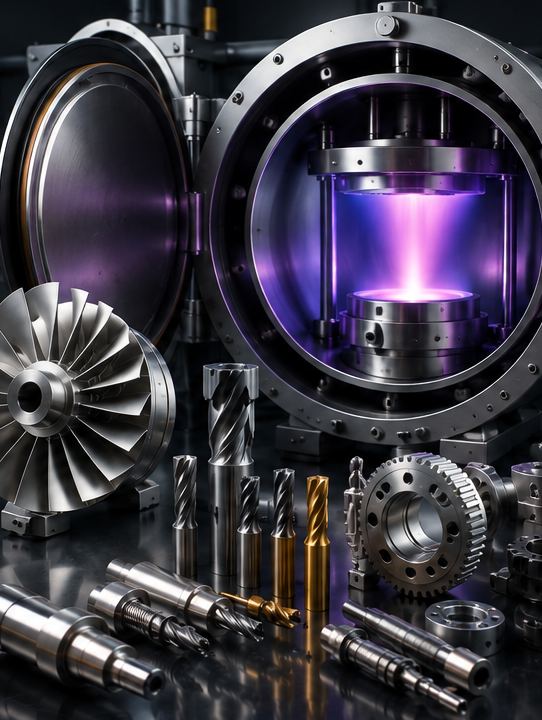
Physical vapor deposition coating is a vacuum-based process that deposits thin, hard films onto substrates by vaporizing a solid target material (titanium, chromium, zirconium, aluminum, or a combination) and reacting it with a process gas to form a wear-resistant surface. The physical vapor deposition process operates at relatively low temperatures (typically below 500°C), preserving the substrate's heat treatment, geometry, and dimensional accuracy. The resulting PVD coating creates a dense, well-adhered film at 1 to 7 µm thickness with hardness values ranging from 1,800 to 4,500 HV depending on the coating type selected. ACT uses PVD arcing and sputtering methods in partnership with Platit equipment to apply 20+ vapor deposition coating options across cutting tools, aerospace components, medical instruments, firearms parts, automotive drivetrain assemblies, and industrial wear parts. Each PVD coating service project includes substrate evaluation, coating selection, controlled deposition, and documented quality inspection.

1–7 µm Coating Thickness

Ultra-thin coatings that deliver maximum protection without altering part tolerances.

1,800 – 4,500 HV Hardness

High hardness coatings engineered to resist wear, abrasion, and surface fatigue.

Low Temperature Process < 500°C

Preserves substrate properties, heat treatment, and dimensional accuracy.

Key Benefits

Superior Wear Resistance
Our PVD coatings provide exceptional
wear resistance, significantly extending
the life of your components and tools.
Low Coefficient of Friction
Reduced friction means better
performance, less heat generation, and
improved efficiency in your applications.
High Hardness and Durability
Achieve extreme hardness levels while
maintaining excellent adhesion and
surface integrity.
Temperature and Corrosion
Resistance
Excellent performance in harsh
environments with superior resistance to
temperature and corrosion.
Wide Range of Aesthetic
Finishes
Available in various colors and finishes to meet both functional and aesthetic
requirements.
Environmentally Responsible
Process
Eco-conscious coating solution that
minimizes environmental impact while
maximizing performance.

Trusted Experts in Physical Vapor Deposition Coating

Our physical vapor deposition coating solutions deliver exceptional durability, performance, and consistency. With decades of expertise in PVD coating service, we help manufacturers reduce wear and optimize tool life. This low-friction coating technology enables smoother operation and enhanced efficiency, even in extreme environments. Our physical vapor deposition methods ensure a high-performance result every time, whether you're focused on improving precision or reducing maintenance. Backed by industry-leading service and innovation, ACT’s coatings are engineered to reduce friction and maintain low-friction performance over time.

Why Choose Our PVD Coating Service

Superior wear resistance with hardness values from 1,800 HV (CrN) to 4,500 HV (AlTiSiN, nACO, WARRIOR) for longer component life

Low friction coating options including TiCN (COF 0.25), CrN (COF 0.30), and ZrN (COF 0.30) for smoother operation and reduced energy loss

Enhanced surface durability through atomic-level bonding that resists chipping, flaking, and delamination under operating loads

Temperature resistance up to 1,200°C (AlTiSiN, nACO) for components in high-heat machining, aerospace, and engine environments

Corrosion resistance from CrN, ZrN, and DLC protecting parts against chemical attack, bodily fluids, and environmental exposure

Precise coating thickness of 1 to 7 µm with strong adhesion, preserving part tolerances without post-coating grinding

Compatible with metals including carbide, HSS, tool steel, stainless steel, titanium, aluminum, bronze, and copper

Reduced downtime, maintenance, and replacement costs through extended tool and component life

Consistent PVD coating quality verified through in-house Calo Testers, Fisherscope X-ray systems, Tribo Meters, and optical microscopes under AS9100D and ISO 9001:2015 controls

Frequently Asked Questions

What materials can be coated with PVD?

PVD can be applied to metals preferably stainless steel

How thick are PVD coatings?

Typical thickness ranges from 1 to 2 microns, offering high surface hardness without altering part dimensions.

Can PVD coatings improve tool life?

Yes. PVD coatings significantly reduce wear, friction, and heat build-up, often doubling or tripling the life of cutting tools and components.

Are PVD coatings corrosion-resistant?

Yes, PVD coatings offer good to excellent corrosion resistance, especially when paired with a proper pre-treatment or substrate.

Do PVD coatings come in different colors?

Absolutely. PVD coatings can be deposited in gold, black, rainbow, bronze, chrome, and other colors

How do low-friction products improve the performance of industrial tools and parts?

A low-friction coating reduces heat buildup, minimizes wear, and enhances efficiency in machining and moving parts. This extends component life, increases productivity, and supports reliable performance in demanding industrial applications.

What advantages can manufacturers expect from a professional physical vapor deposition service?

Our physical vapor deposition coating service delivers durable, uniform finishes that resist wear and corrosion. This advanced process improves hardness, reduces maintenance needs, and provides long-term performance benefits for tools and precision components.

The page mentions PVD thickness of 1 to 2 microns. Can thicker PVD coatings be applied for more demanding applications?

Yes. While 1 to 2 µm is typical for many applications, ACT applies PVD coatings up to 7 µm depending on the coating type and application requirements. TiN, for example, can be applied at 1 to 7 µm. The appropriate thickness is determined during consultation based on your part's operating conditions and tolerance constraints.

How does ACT determine which PVD coating type is best for my application out of the 20+ options available?

ACT's team evaluates your substrate material, the dominant wear mechanism (abrasion, friction, or corrosion), operating temperatures, and any regulatory or documentation requirements. This assessment, supported by a Ph.D. scientist on staff, narrows the options from 20+ coatings to the one that matches your specific conditions.

Can PVD coatings be applied to 3D-printed or additively manufactured metal parts?

Yes, in many cases. PVD coatings can be applied to additively manufactured parts made from compatible metals (stainless steel, titanium, tool steel). Surface preparation is particularly important for 3D-printed parts because as-printed surface roughness and porosity can affect coating adhesion. ACT can evaluate your specific part.

Does the PVD process alter the heat treatment or hardness of the base material?

No. PVD deposition occurs at relatively low temperatures (typically below 500°C), which preserves the substrate's existing heat treatment, mechanical properties, and dimensional accuracy. This is one of PVD's advantages over higher-temperature coating processes.

The comparison table shows PVD as "line-of-sight." Does that mean internal surfaces cannot be coated?

PVD is primarily a line-of-sight process, meaning surfaces that face the coating source receive the best coverage. Deep internal bores, blind holes, and heavily recessed geometries may receive thinner or inconsistent coverage. For parts with internal surfaces that require full coverage, ACT's CVD DLC process is better suited because it reaches all exposed surfaces through reactive gas chemistry.

Coating Technology Comparison

Compare our coating technologies to find the best solution for your application
Feature / Property
PVD
CVD
MoS₂
Coating Type
Thin film, hard surface coating
Conformal, dense chemical coating
Solid film lubricant
Application Method
Vacuum deposition
High-temperature gas-phase
reaction
Spray or vacuum-applied dry film
Operating Environment
High wear, moderate to high
temperatures
Extreme temperatures, corrosive
conditions
Dry, vacuum, space, high-load
environments
Surface Coverage
Line-of-sight, less effective on
complex parts
Excellent on complex/internal
geometries
Uniform on most surfaces
Friction Coefficient
Low
Moderate
Very Low
Temperature Resistance
High
Very High
High
Wear Resistance
Excellent
Excellent
Good
Corrosion Resistance
Moderate to High
Excellent
Moderate
Thickness Control
Precise, but thin
Uniform across complex shapes
Variable; depends on application method
Materials Coated
Metals, plastics, glass
Primarily metals, ceramics
Metals, alloys, and some non-metals
Best For
Tools, dies, decorative parts,
medical devices
Aerospace, energy, semiconductors,
harsh environments
Aerospace, defense, vacuum
systems, precision equipment
Lubrication Properties
Minimal
None
Excellent
Aesthetic Options
Wide range of colors and
finishes
Limited
Matte grey finish
Environmental Friendliness
High
Moderate
High
Feature / Property
PVD
Coating Type
Thin film, hard surface coating
Application Method
Vacuum deposition
Operating Environment
High wear, moderate to high
temperatures
Surface Coverage
Line-of-sight, less effective on
complex parts
Friction Coefficient
Low
Temperature Resistance
High
Wear Resistance
Excellent
Corrosion Resistance
Moderate to High
Thickness Control
Precise, but thin
Materials Coated
Metals, plastics, glass
Best For
Tools, dies, decorative parts,
medical devices
Lubrication Properties
Minimal
Aesthetic Options
Wide range of colors and
finishes
Environmental Friendliness
High

Need Help Choosing?

Our coating experts can help you select the optimal solution for your specific application requirements.
Consult with Our Experts

Copyright © 2012 - 2025 | Advanced Coating Technologies, Inc.