hi-res-ac

Aerospace and Space

In Aerospace and Space applications, even the smallest components must often withstand extreme conditions of pressure and temperatures. ACT coatings are engineered for high temperature, high stress, and vacuum environments—delivering reliability where it matters most.

Coating Services

ACT provides PVD and CVD coatings that have conformal coverage, consistent finish, and excellent adhesion. Our coatings could be tailored to meet custom specifications to propel your space- or aircraft  . 

ACT is proud to have been working with the NASA Jet Propulsion Laboratory (JPL) on one of their last Mars missions. Tested by Caltech, ACT coated hinges and bearings to ensure the movement of the cameras and wheels with our MoS2 coating.

We work with the largest California-based Aerospace and Space companies to provide high-temperature PVD coatings for jet engine components and ensure that their often mission-critical components are properly protected by ultrathin coatings, which provide wear resistance and ultra-low friction.

Applicable Coatings: All sputtered PVD coatings, TiN, CrN, Diamond-Like-Carbon (DLC), MoS2 

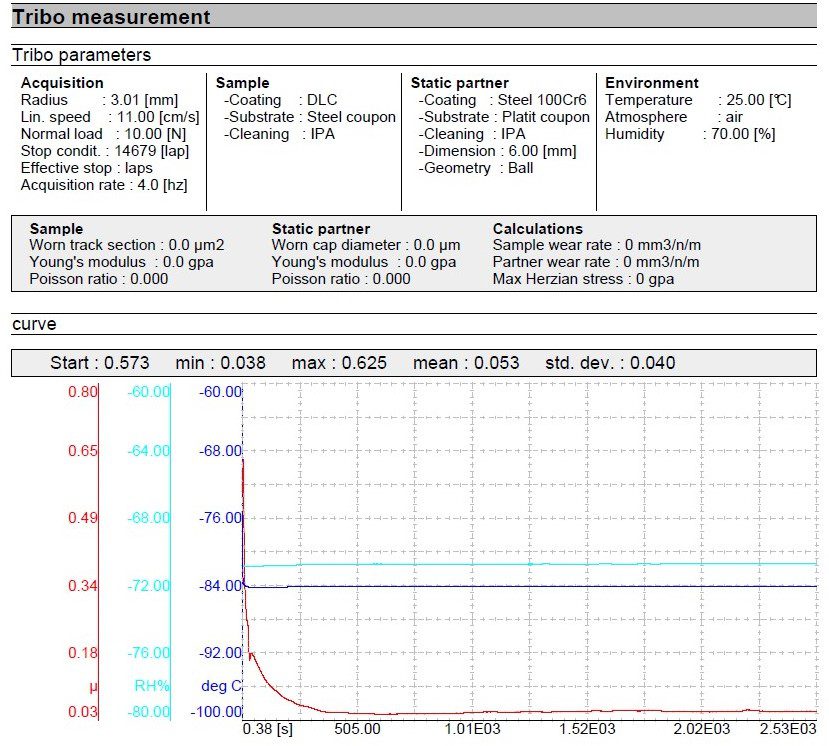
Shown below is the coefficient of friction (CoF) for DLC at ambient atmosphere.

Request a Quote

Request A Quote

PVD and DLC Coatings Engineered for Aerospace Components

Bearings, gears, valves, molds, and precision mechanisms operating under sustained heat, thermal cycling, and mechanical stress require coatings that match properties to the specific demands of the application. PVD coatings like AlTiN (HV 3,400 to 3,600, max 700°C) and AlTiSiN (HV 4,500, max 1,200°C) resist oxidation and maintain hardness at the elevated temperatures aerospace components encounter in service. For precision mechanisms where sliding friction drives wear, DLC (COF 0.05 to 0.1) and X-LC (COF 0.02 in nitrogen) provide friction reduction in environments where conventional lubricants cannot function. High-temperature PVD coatings for jet engine components and related assemblies maintain their protective properties through sustained thermal exposure, while ultrathin PVD coatings for aerospace parts at 1 to 4 µm preserve the tight tolerances and dimensional accuracy that aerospace specifications demand. Our aerospace PVD coating services are applied under AS9100D and ISO 9001:2015 quality controls with full lot traceability.

20+ Coating Options

Specialized PVD and DLC coatings for aerospace-grade performance.

Up to 3,600 HV Hardness

High hardness coatings built to withstand extreme conditions.

0.05 – 0.1 COF Low Friction

Specialized PVD and DLC coatings for aerospace-grade performance.

Coating Advantages

Aerospace parts operate in unforgiving environments: zero gravity, intense heat, constant vibration. Our coatings are developed to survive—and thrive—under these extreme conditions.
Download Aerospace Flyer
  • Reduced friction and wear
  • Provides thermal stability
  • Increased lubricity to minimize potential hazards
  • Improved hardness and smoothness of the material
  • Protect against corrosion with enrichment of the surface layers

Recommended Coatings for Aerospace

TiN
AlTiN
TiAlN
ZrN
CrN
DLC
DLC Plus
NACO
NACRO
ALTISIN
X-LC (MOS)
Quantum(x)
NEXCEL

ACT provides coatings that offer a uniform and consistent finish. The coatings ensure proper tolerance and are tested to ensure safety requirements are met.

In the aerospace industry, severe abrasive wear and crack formation can occur in components due to fretting (adhesive transfer of material between contacting surfaces. Our aerospace PVD coating services deliver high hardness and low friction, making them ideal for protecting aerospace and mechanical components in jet engines from such damage. PVD coatings help ensure optimal performance and durability under extreme conditions.

These coatings are suited to high-temperature endurance, fluctuating temperatures, and extreme conditions. The coatings improve wear resistance and increase the lifetime of the component. Ultimately, this will save you time and money by avoiding repairs and equipment replacement.

PVD coating applications can be used for:


  • Turbines
  • Compression blades
  • Bearings
  • Mounts
  • Knuckle joints
  • Ball screws
  • Fittings
  • Assembly guides
  • Piston heads
  • Ice cutters
  • Functional instrumentation.

Who We Are

As one of the country’s leading service providers of surface coating technologies, Advanced Coating Technologies (ACT) has developed a range of surface engineered solutions along with our company being certified to handle all aerospace components for coatings. Our AS9100 License allows us to expand our horizons to apply our exclusive advanced coatings to your aerospace components. Many of our products are used throughout the aerospace industry. Our coatings can help improve efficiency, increase durability, and enhance the performance of your components.

With critical devices, the right advanced coating is extremely important in reducing long-term damage and providing outstanding protective properties to increase the lifetime of the component. ACT has a leading research & development team experienced with the aerospace industry and we are closely located to numerous aerospace company headquarters. We offer advanced coating solutions to the aerospace industry that exceed your specifications.

Rectangle

You Make It First, We Make It Last!

Blank Form (#5)

PVD Coatings for Automotive Components and Manufacturing Tools

Aerospace PVD coating services backed by AS9100D and ISO 9001:2015 certification with documented process controls and lot traceability for every order

Coatings rated up to 1,200°C (2,200°F) for components exposed to sustained high-temperature environments

Hardness options from 1,600 HV (DLC) to 4,500 HV (AlTiSiN, nACO) matched to specific wear and fretting resistance requirements

Ultrathin PVD coatings for aerospace parts applied at 1 to 4 µm, preserving finished tolerances without post-coating machining

X-LC (MoS2) coatings with COF as low as 0.02 for vacuum and space applications where liquid lubricants are not viable

In-house inspection using Calo Testers, Fisherscope X-ray systems, Tribo Meters, and optical microscopes

Ph.D. scientist on staff providing data-backed coating selection based on substrate, operating environment, and performance targets

Fretting and oxidation resistance for bearings, gears, valves, and mechanisms subject to thermal cycling and vibration

PVD and DLC Coating Capabilities advanced PVD and DLC coatings designed for durability, wear resistance, and high performance

Extensive Material and Coating Testingin-house testing to validate hardness, thickness, adhesion, and performance under real-world conditions

Industry-leading research and development team driving innovation in coating technologies for Aerospace and Space applications

Customized finishes to match your performance and brand goalsfrom functional properties to appearance, we tailor coatings to your exact needs

ISO 9001 & AS9100 certified quality management systems ensuring consistency, traceability, and compliance

Trusted by performance brands and custom shops nationwide proven results and long-term partnerships across the industry

Enhanced Quality Control & Quick Turn around rigorous quality checks and efficient processes to meet tight deadlines

Frequently Asked Questions

What performance benefits do aerospace PVD coating services provide for critical components?

Aerospace PVD coating services improve wear resistance, reduce oxidation, and enhance thermal protection, making them essential for turbine blades, fasteners, and structural parts operating in high-stress flight environments.

Why are high-temperature PVD coatings for jet engine components necessary?

High-temperature PVD coatings for jet engine components protect against thermal degradation, oxidation, and metal fatigue, helping extend service life and maintain performance under extreme operating conditions and rapid temperature fluctuations.

How do ultrathin PVD coatings for aerospace parts affect component efficiency?

Ultrathin PVD coatings for aerospace parts provide a lightweight, low-friction surface that maintains dimensional precision, reduces wear, and supports fuel efficiency without adding bulk or compromising part tolerances.

How do I know which coating is right for my specific part or application?

The selection starts with your operating conditions: the dominant wear mechanism (abrasion, friction, or corrosion), the temperatures your part will see in service, and your substrate material. ACT's team, including a Ph.D. scientist on staff, reviews these variables with you and recommends a coating from over 20 options based on the data, not a default specification.

How long does a typical coating project take from quote to delivery?

Project timelines depend on the coating type, part quantity, and any special preparation or documentation requirements. ACT provides clear communication from quote through delivery so your team can plan production schedules accordingly. Contact us directly for a timeline estimate on your specific project.

Can ACT coat parts that have already been machined to final tolerances?

Yes. PVD and DLC coatings are applied at 1 to 7 µm thickness, which keeps most finished parts within their original tolerance bands. A 3 µm coating adds just 6 µm to the total diameter of a cylindrical part, so post-coating grinding is not typically required.

What certifications does ACT hold for regulated industry work?

How do ultrathin PVD coatings for aerospace parts affect component efficiency?

ACT is certified to AS9100D and ISO 9001:2015, which govern quality management, process documentation, and lot traceability for aerospace and other regulated industries. ACT also holds a Federal Firearms License (FFL), authorizing the facility to receive and process serialized firearms, components, and assembled weapons.

What testing is performed on coated parts before they ship?

ACT performs in-house quality inspection using Calo Testers for thickness measurement, Fisherscope X-ray systems for non-destructive thickness and composition analysis, Tribo Meters for friction verification, and optical microscopes for visual surface inspection. Results are documented and included with the order as part of the quality record.


Copyright © 2012 - 2025 | Advanced Coating Technologies, Inc.